
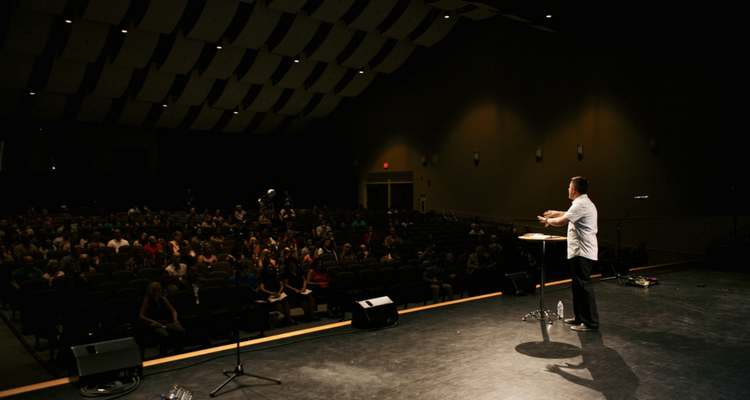
I was ready to call it all off. On the surface they were getting it. They could repeat my main point, apply it to hypothetical situations, analyze and critique. They could explain why it was important, and they wanted to live it out. Still, underneath the mental assent, they were not getting it. I had spent 10 hours in message prep, yet there was no visible change, just more content that I had passed along.
My assumptions about teaching and learning were centered on transmitting information. I was the dump truck that delivered the goods directly into their brains. I basically saw them as empty vessels, holes even, in need of filling. Besides not being very effective, I believe I suffered from a low view of the Imago Dei in those I taught.
Then I discovered something the church has known for a very long time. God’s Word, church history and good educational theory convinced me to use a much fuller, three-dimensional approach in my discipleship and teaching practice: The Head, The Heart and The Hands.
Dimension #1: The Head (Rational Dimension)
Rooted in the approach of doctrinal revelation, I found myself teaching solely in this area. My thoughts were: God has spoken; thus, we should know what He has revealed to us. We are to renew our minds and know the truth.
I like J.B. Phillips’ translation of Romans 12:1-2: “Don’t let this world squeeze you into its mold.” We find that truth is liberating. “Then you will know the truth, and the truth will set you free” (John 8:32). We find that truth actually sanctifies us! “Sanctify them by the truth; your word is truth” (John 17:17). Truth is essential. We must learn to think God’s thoughts. Regular Bible exposure is essential to Christian living.
Of course there is a danger here of confusing the process of accomplishment with our ultimate goal. We cannot confuse biblical knowledge with spiritual maturity. Just because we or our students can quote, teach and argue the Bible does not mean we are transformed by it. Memorization and orthodoxy are a means to an end. It is possible to know a great deal of Scripture and not be spiritually mature. Knowledge is necessary but not sufficient. However, it is not possible to be spiritually mature without knowing Scripture.
The question each of us should ask about our teaching is, “What do I want my students to know?”
Dimension #2: The Heart (Affective Dimension)
When I think of spirituality, the heart dimension comes to mind. The heart is concerned primarily with loving and valuing God. The goal is to experience the presence of God. Personal, relational knowledge of God is central to our spiritual health and growth. Our faith must be felt, experienced and most importantly, valued. The desert fathers exemplify this, not as an escape of the evils of this world, but as a focus on and engagement with God. The fundamental concept is that God is here and we must love and value Him and all that He values.
Scripture is replete with examples of how God interacts with us personally. Paul prays that we “grasp how wide and long and high and deep is the love of Christ, and to know this love that surpasses knowledge” (Ephesians 3:18-19). God “is mighty to save. He will take great delight in you, He will quiet you with His love, He will rejoice over you with singing” (Zephaniah 3:17).
Naturally, we are wary of these truths because the values and movements of the heart are tested in time and against Scripture. The danger is that personal, emotive experiences of God may not be from God at all. It is certainly possible to be passionate and emotional and not be mature. Emotion is necessary but not sufficient. However, we must remember we cannot be mature without valuing, loving and seeking to please God. Our concern is for our students to love God, desire what He desires and delight in knowing and pleasing Him.
The question to ask ourselves is, “What do I want my students to feel?”
Dimension #3: The Hands (Behavior Dimension)
The third dimension is concerned dominantly with issues of justice. It allows us to see our spiritual lives through the lens of obedience to God. Authentic spiritually always drives us into redemptive involvement with the broken world.
Health in the first two dimensions naturally moves us to work and serve in God’s world. The third dimension holds a deep concern for the outworking of our faith and matters of justice. The goal is to see the Kingdom of God lived out. Spirituality must affect our wills in the choices we make. Oppression of others (racism, sexism, exclusion of social outcasts, etc.) must be confronted in the name of Christ. Christian spirituality must be worked out in the social arena. Every high school and community is filled with opportunities to be the hands of Jesus.
This third area is also deeply biblical. Micah asks, “What does the LORD require of you? To act justly and to love mercy and to walk humbly with your God” (Micah 6:8). The Book of James states, “Religion that God our Father accepts as pure and faultless is this: to look after orphans and widows in their distress and to keep oneself from being polluted by the world” James 1:27).
Knowledge and love require action. It is possible to act with concern and mercy and not be spiritually mature. Action is necessary but not sufficient. However, it is not possible to be spiritually mature and not act with compassion and social concern.
The question to ask is: “What do I want to see my students do?”
These discoveries dramatically have enhanced the biblical foundation of my teaching. As I plan a message, program or activity, I not only am concerned with the target audience and the knowledge to be communicated, but now I am concerned with all three dimensions in order to develop holistic and mature disciples.
Getting Practical
How does this impact us as we write our messages or plan our programs? First, we must have very clear objectives. What exactly are we trying to instill/teach/grow/develop in those we teach? Sometimes the content is clear, but we do not often think in other dimensions. Each teaching should include three objectives.
The first is for the head: “What do I want them to understand, know, think through, apply and judge?” For example: The students should understand how to steward gifts, time and money.
The second objective is for the heart or affect: “What emotion, desires and values should be instilled through this teaching?” (Example: Students will value people rather than possessions.)
The third objective concerns the hands: “What behaviors, skills, habits and actions am I trying to produce?” (Example: Students will tithe regularly to support a youth group mission.)
When we are absolutely clear and concise about what we are trying to accomplish, we drastically improve the probability of making it a reality. Once we have objectives in all three areas, then we ask: How we can develop these in our teaching?
Here is a concrete stewardship example: Give each student a fake $1,000 bill. Have each write a list of what he or she would buy with the money if it were real. Next, use a song that advocates the “good life” (such as Weezer’s “Beverly Hills”), but display pictures of the poor, disenfranchised and hurting while the song plays. Present a message about stewardship then have students rewrite their wishful spending list in small groups. Have the groups brainstorm ways to support the project your youth ministry is supporting. Allocate time and resources to carry out their actions.
Generally Speaking
Head: There are many ways to communicate rational truth. In addition to lectures, do we engage students in questioning and owning their faith? How about panel discussions, memorization, debate, lectio divina, playing devil’s advocate and posing rhetorical questions? Are we more worried about content than developing godly wisdom? One way to do this is move beyond recall and comprehension. Students should be able to apply, analyze, synthesize, judge and create new combinations with the information. The most important thoughts we will have are our thoughts about God.
Heart: There are many approaches to find a direct experience with God. Do we or our teens ever engage in personal retreats, quiet times, solitude, listening for God’s voice, contemplation, introspection or meditation? We must slow down and make space. I once heard someone say, “We do so much talking in our prayers that I wonder if we can even hear God when He speaks.” Some of these concepts are easily included within messages and are powerful in new spaces such as retreats and mission trips.
Hands: There are many approaches to live out the justice of God in our ministries. Do we reach out to the poor and disenfranchised, call students to sacrificial giving, take them to soup kitchens or encourage them to sit with the lonely during lunch? Do we take out the widow’s garbage? Do we preach evangelism and allow for students to practice sharing their faith and testimonies in youth group? If we tell them they have gifts to give and a unique identity, we must allow them to express their identity and use their gifts. If your youth group left your town, would the town notice the gap? The sit-and-soak approach to teaching cultivates passivity. Active teaching involving the hands promotes obedience to the Word.
In the past, I would inform those I taught, which was simple addition of information. The threefold approach modeled and taught in Scripture calls us to teach in a way that transforms. My guess is that in your ministry you have had moments when these three combined into a powerful work of God. When all three dimensions work together, we are awed and in wonder about God transforming lives within our ministries.